
Guide · Devotion
The Divine Mercy image and chaplet: St Faustina’s devotion explained
Jesus in a white robe, one hand raised in blessing, two rays streaming from His heart, and five words beneath: “Jesus, I trust in You.” The Divine Mercy image is now one of the best-loved in Ireland.
St Faustina
Helena Kowalska was born on 25 August 1905 in a village in central Poland, the third of ten children of a poor family. She entered the Congregation of the Sisters of Our Lady of Mercy, taking the name Sister Maria Faustina of the Blessed Sacrament, and worked as a cook, gardener and porter in the congregation’s houses. She died of tuberculosis in Kraków on 5 October 1938, aged 33.
At the request of her confessor she kept a diary, now published as Divine Mercy in My Soul, recording the revelations she received. Pope St John Paul II, who as Archbishop of Kraków had opened the process for her beatification, beatified her in 1993 and canonised her on 30 April 2000 — the first saint of the new millennium. Her feast is 5 October.
The image
On the night of 22 February 1931, in her convent at Płock, Faustina saw Jesus dressed in a white garment, one hand raised in blessing and the other touching the garment at His breast, from which came two large rays, one pale and one red. He asked her to have the image painted as she saw it, with the signature “Jesus, I trust in You.” The first painting was made in Vilnius in 1934 by Eugeniusz Kazimirowski, under the direction of her confessor, Blessed Michael Sopoćko.
In her diary she records that Jesus explained the rays: the pale ray stands for the water which makes souls righteous, and the red ray for the blood which is the life of souls — the blood and water that flowed from His pierced side on the Cross.
How to pray the chaplet
Use ordinary rosary beads
The chaplet is prayed on a rosary and takes about seven minutes.
Opening prayers
Begin with the Sign of the Cross, an Our Father, a Hail Mary and the Apostles’ Creed.
On each large bead
“Eternal Father, I offer You the Body and Blood, Soul and Divinity of Your dearly beloved Son, Our Lord Jesus Christ, in atonement for our sins and those of the whole world.”
On each of the ten small beads
“For the sake of His sorrowful Passion, have mercy on us and on the whole world.”
Repeat for five decades
Go round the beads, as with the Rosary, five times.
To finish, three times
“Holy God, Holy Mighty One, Holy Immortal One, have mercy on us and on the whole world.”
Divine Mercy Sunday and the Hour of Mercy
Our Lord asked through St Faustina for a feast of Mercy on the Sunday after Easter. Pope St John Paul II granted it at her canonisation in 2000: the Second Sunday of Easter is now Divine Mercy Sunday throughout the Church. Many parishes keep a novena of chaplets beginning on Good Friday and ending on the Saturday before the feast, and have Confession, Adoration and the chaplet on the Sunday afternoon.
Three o’clock in the afternoon, the hour Christ died, is kept as the Hour of Mercy. Even a moment of prayer then — or the chaplet itself — is a simple way to live the devotion every day.
Divine Mercy statues
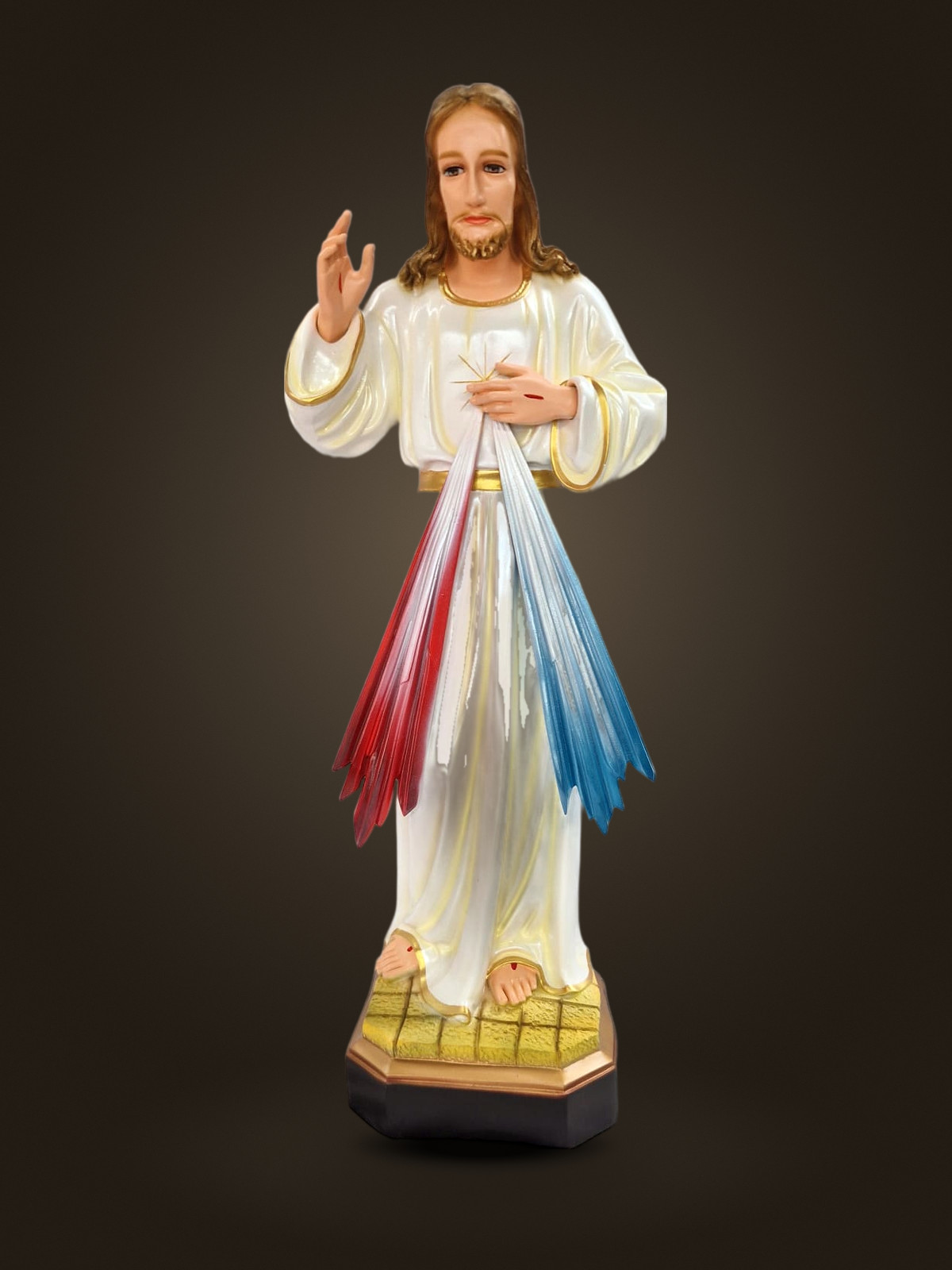
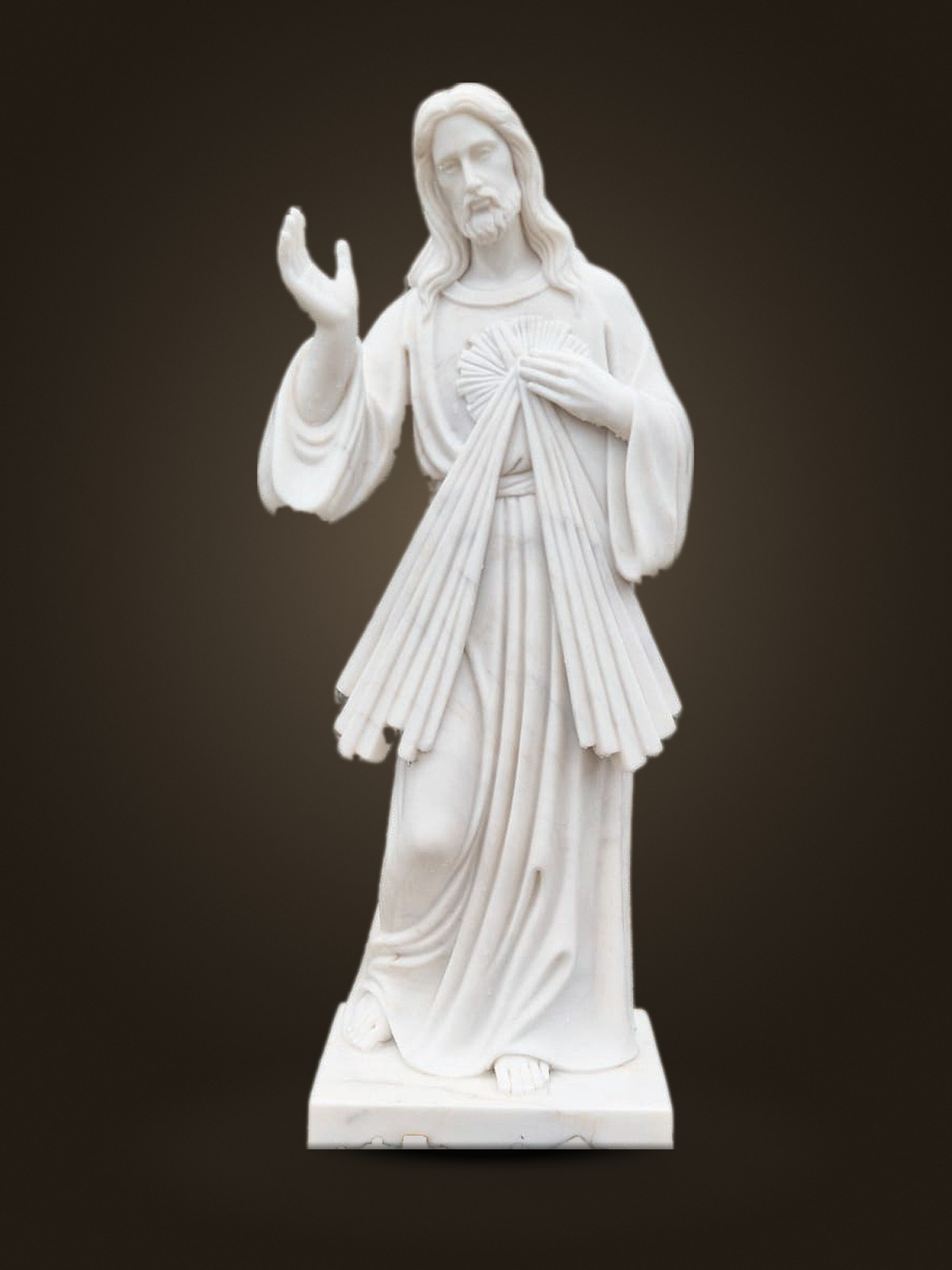
Statues of the Merciful Jesus in painted resin and carved marble.
A Divine Mercy statue at home or in the parish
A painted statue shows the two rays in their colours, which is why most people choose resin for the home. A marble Divine Mercy is quieter, white stone carved with the rays, and suits a church, a memorial or a garden. In a parish, the statue is often placed near the confessionals, or brought forward for Divine Mercy Sunday.
Many families keep the Divine Mercy and the Sacred Heart side by side. They are two expressions of the same love of Christ: the Sacred Heart shows the Heart itself; the Divine Mercy shows what flows from it. The image is also a common and fitting choice for a memorial, because of the promise of mercy at the hour of death.
Questions people ask
When is Divine Mercy Sunday?
The Second Sunday of Easter, one week after Easter Sunday.
What do the two rays mean?
According to St Faustina’s diary, the pale ray stands for the water that makes souls righteous and the red ray for the blood that is the life of souls — the blood and water from Christ’s pierced side.
Do I need special beads for the chaplet?
No. Ordinary rosary beads are used. Some chaplet beads are sold, but they are not needed.
Is the Merciful Jesus the same as the Divine Mercy?
Yes. The image is called the Divine Mercy or the Merciful Jesus; both names refer to the image given to St Faustina.
When is St Faustina’s feast?
5 October, the day she died in 1938.
Read next
Updated
Read next
The Sacred Heart in Irish homes
For generations, the Sacred Heart picture in the kitchen, with its small red lamp and the family’s names written underneath, was as much a part of an Irish home as the range. The devotion behind it is easy to renew.
Memorial statues
When someone dies, a statue can do what flowers cannot: stay. Placed in the house, the garden or at the grave, it becomes the spot where a family keeps praying for the one they have lost.
Church statues
A statue in a church has to read from the back of the nave, suit the building it stands in, and last longer than any of the people who chose it. This page is for parish priests, sacristans and committees working that out.
Padre Pio
A Capuchin friar in a small town in southern Italy, who spent most of his days hearing confessions and bore the wounds of Christ for half a century. Few modern saints are as loved in Irish homes.