
Guide · Our Lady
Our Lady of Fatima: the apparitions of 1917 and their message
Between May and October 1917, three shepherd children in a Portuguese hill village saw a Lady “brighter than the sun”. She asked them to pray the Rosary every day.
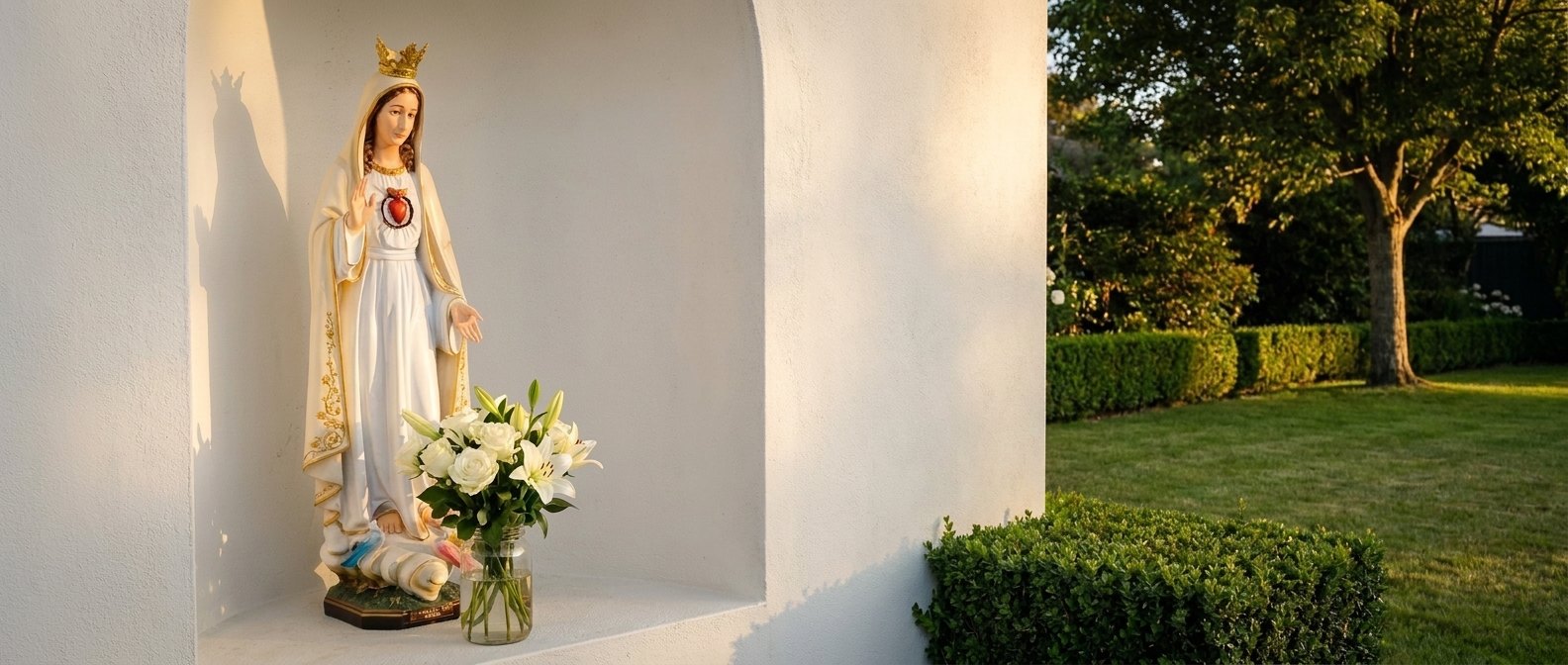
The three children
Lúcia dos Santos, aged ten, and her cousins Francisco Marto, eight, and Jacinta Marto, seven, looked after their families’ sheep near Fatima, in central Portugal. In 1916 they were visited three times by an angel who taught them to pray and to make reparation. On 13 May 1917, at the Cova da Iria, a hollow where they were grazing the flock, they saw a Lady dressed in white, standing above a small holm oak.
The six apparitions
Our Lady asked the children to return on the thirteenth of each month.
13 May 1917
The first apparition. The Lady asked the children to come back on the 13th of each month for six months and to pray the Rosary every day.
13 June 1917
She told them that Francisco and Jacinta would soon be taken to heaven, but that Lúcia would stay longer to spread devotion to her Immaculate Heart.
13 July 1917
The children were shown a vision of hell and given the message later called the secret of Fatima, including the call to devotion to the Immaculate Heart.
19 August 1917
On the 13th the children had been taken away and held by the local administrator, so the apparition came a few days later, at Valinhos, near their village.
13 September 1917
A large crowd was present. The Lady again asked for the daily Rosary and promised a miracle in October.
13 October 1917
Before a crowd of tens of thousands in the rain, the Lady named herself “the Lady of the Rosary”. Many present saw the sun appear to spin and plunge — the miracle of the sun.
The message
The heart of Fatima is simple: pray the Rosary every day, for peace and for sinners; make sacrifices and offer them in reparation; turn back to God. Our Lady asked for devotion to her Immaculate Heart, and later, in later apparitions to Lúcia as a young religious, asked for the Communion of reparation on the First Saturday of five consecutive months.
The children also learned a short prayer, which Catholics now add after each decade of the Rosary: “O my Jesus, forgive us our sins, save us from the fires of hell; lead all souls to heaven, especially those most in need of Thy mercy.”
The bishop of Leiria declared the apparitions worthy of belief in 1930. Popes since have been closely linked with Fatima. Pope St John Paul II, shot in St Peter’s Square on 13 May 1981, the anniversary of the first apparition, credited Our Lady with saving his life, and one of the bullets was later set into the crown of the statue at Fatima.
St Francisco and St Jacinta
As Our Lady had told them, the two younger children died young, in the influenza epidemic that followed the First World War: Francisco on 4 April 1919, Jacinta on 20 February 1920. They were canonised by Pope Francis at Fatima on 13 May 2017, the centenary of the first apparition, and are among the youngest saints who were not martyrs. Lúcia became a Carmelite nun and died on 13 February 2005, aged 97.
The memorial of Our Lady of Fatima is kept on 13 May. The feast of Sts Francisco and Jacinta Marto is 20 February.
Reading a Fatima statue
All in white
The children described the Lady as dressed in white, brighter than the sun. Fatima statues show a white mantle, usually edged with gold.
Hands joined, with a rosary
Her hands are joined at the breast with a rosary hanging from them.
A star at the hem
Many Fatima statues have a small gold star near the hem of the mantle.
The Immaculate Heart
Some versions show her heart, surrounded by thorns, linking the statue to devotion to the Immaculate Heart.
The crown
The statue in the Chapel of the Apparitions was crowned in 1946, and many statues carry a crown.
Our Lady of Fatima statues
Fatima statues and the Immaculate Heart of Mary, as they stand in the catalogue today.
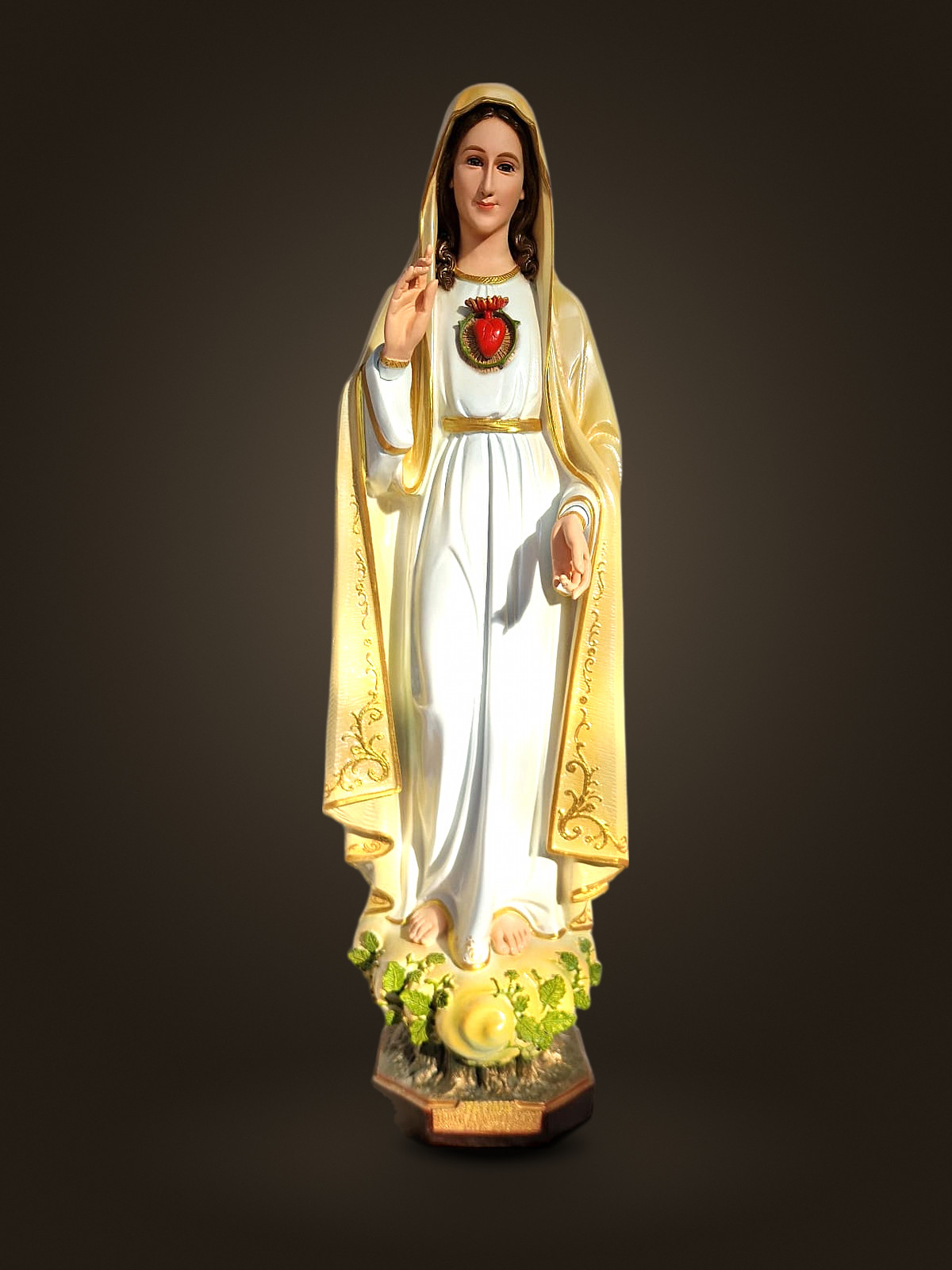
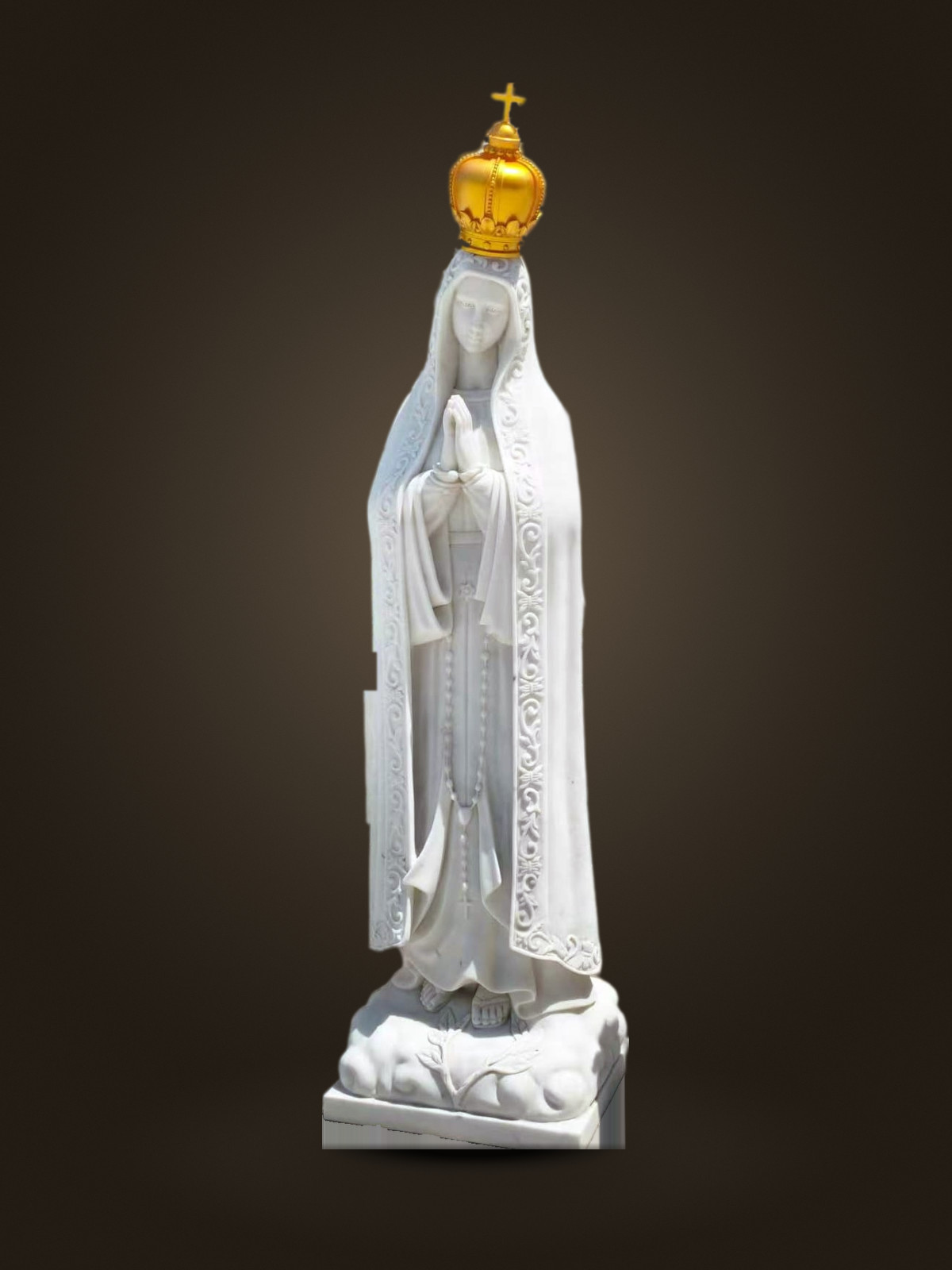
A Fatima statue in an Irish home or parish
In Ireland, Fatima has always been bound up with the family Rosary. A Fatima statue suits a home where the Rosary is said, a parish Rosary group, a school prayer room or a grotto. In October, the month of the Rosary, and in May, many families give her a place of honour; see our guide to making a May altar.
If you are choosing between Fatima and another Marian title, think about the devotion behind it. Fatima speaks of the Rosary and reparation; Lourdes of the sick and of the Immaculate Conception; Knock of silent prayer and the Eucharist, and of Ireland itself.
Questions people ask
How many times did Our Lady appear at Fatima?
Six times in 1917, on 13 May, 13 June, 13 July, 19 August, 13 September and 13 October, to Lúcia, Francisco and Jacinta.
What did Our Lady ask for at Fatima?
Daily prayer of the Rosary for peace and for sinners, sacrifices offered in reparation, and devotion to her Immaculate Heart.
What is the Fatima prayer?
“O my Jesus, forgive us our sins, save us from the fires of hell; lead all souls to heaven, especially those most in need of Thy mercy.” It is said after each decade of the Rosary.
When is the feast of Our Lady of Fatima?
13 May, the anniversary of the first apparition.
What is the First Saturday devotion?
Confession, Holy Communion, five decades of the Rosary and fifteen minutes’ meditation on its mysteries, in reparation to the Immaculate Heart of Mary, on the first Saturday of five consecutive months.
Read next
Updated
Read next
Our Lady of Lourdes
In 1858 a poor, asthmatic fourteen-year-old in the south of France saw a young Lady in a rock cave by the river. Her name was Bernadette Soubirous, and the cave was Massabielle, at Lourdes.
Our Lady of Knock
On a wet Thursday evening in August 1879, people in a small Mayo village saw Our Lady, St Joseph and St John the Evangelist at the gable wall of their parish church. Not a word was spoken. Ireland has been going to Knock ever since.
Making a May altar
In Irish classrooms and kitchens, May has long meant a small altar to Our Lady: a statue, a blue cloth, a jam jar of flowers the children picked on the way to school. It is one of the easiest devotions to begin.
Statues for the home
A statue in the house is a face to turn to at the start of the day and at the end of it. Here is how to choose one for a shelf, a sill or a prayer corner — and which statues Irish homes have kept for generations.