
Guide · Our Lady
Our Lady of Lourdes and St Bernadette: the story behind the statue
In 1858 a poor, asthmatic fourteen-year-old in the south of France saw a young Lady in a rock cave by the river. Her name was Bernadette Soubirous, and the cave was Massabielle, at Lourdes.
The apparitions
On 11 February 1858, Bernadette Soubirous went with her sister and a friend to gather firewood near the grotto of Massabielle, on the edge of Lourdes. There, in a niche in the rock, she saw a young Lady dressed in white, with a blue sash and a rosary, and a yellow rose on each foot. Between that day and 16 July 1858, Bernadette saw the Lady eighteen times.
The Lady asked her to pray for sinners, called for penance, asked that a chapel be built and that people come in procession. On 25 February she told Bernadette to drink from a spring and wash in it; Bernadette scratched at the muddy ground and a spring appeared, which still flows in the grotto. On 25 March, the feast of the Annunciation, Bernadette asked the Lady her name, and was told, in the local dialect: “I am the Immaculate Conception.”
Why “the Immaculate Conception” mattered
Four years earlier, in 1854, Pope Pius IX had defined as dogma that Mary was preserved from original sin from the first moment of her conception. Bernadette, who had little schooling, did not understand the phrase and repeated it to herself all the way to the parish priest so as not to forget it. The parish priest, who had been sceptical, was shaken. The bishop of Tarbes recognised the apparitions in 1862.
Lourdes became, and remains, one of the great pilgrim places of the world, especially for the sick. Many cures have been reported there; a small number, after long medical investigation, have been declared miraculous by the Church. Irish dioceses send pilgrimages every year, often with a large group of sick pilgrims and young helpers.
St Bernadette
Bernadette was born on 7 January 1844, the eldest child of a miller who had fallen on hard times; when the apparitions began, the family was living in a former prison cell. She was questioned again and again by officials, priests and the curious, and never changed her account. In 1866 she entered the Sisters of Charity of Nevers, where she lived quietly, often ill, and died on 16 April 1879. She was canonised by Pope Pius XI on 8 December 1933, the feast of the Immaculate Conception.
Her feast is kept on 16 April in most places. The memorial of Our Lady of Lourdes is on 11 February, the date of the first apparition; since 1993 it has also been the World Day of the Sick.
Reading a Lourdes statue
Statues of Our Lady of Lourdes follow Bernadette’s description closely.
White robe and veil
She is dressed in white, with a long white veil.
Blue sash
A blue sash or girdle at the waist, hanging down in front — the blue is often the only strong colour on a painted statue.
Hands joined, eyes raised
In the best-known image, her hands are joined in prayer and her eyes lifted, as at the moment she named herself.
Rosary and roses
A rosary hangs over her arm, and a golden rose rests on each foot.
St Bernadette kneeling
Many grottos and statue groups add Bernadette kneeling below, with a rosary in her hands.
Our Lady of Lourdes and St Bernadette
Lourdes statues in painted resin and carved marble, and St Bernadette.
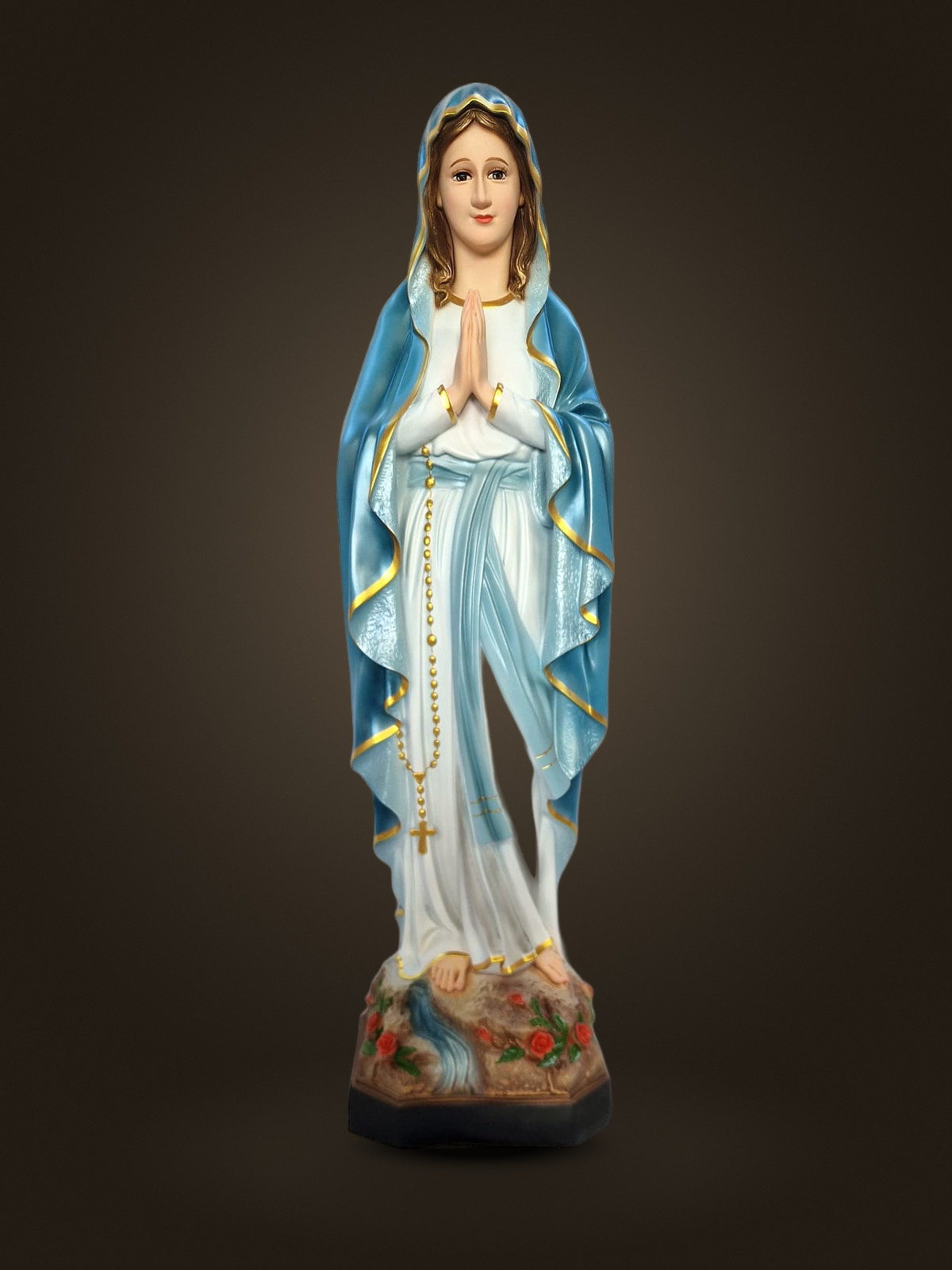
Our Lady of Lourdes
Hand-painted resin
From €55
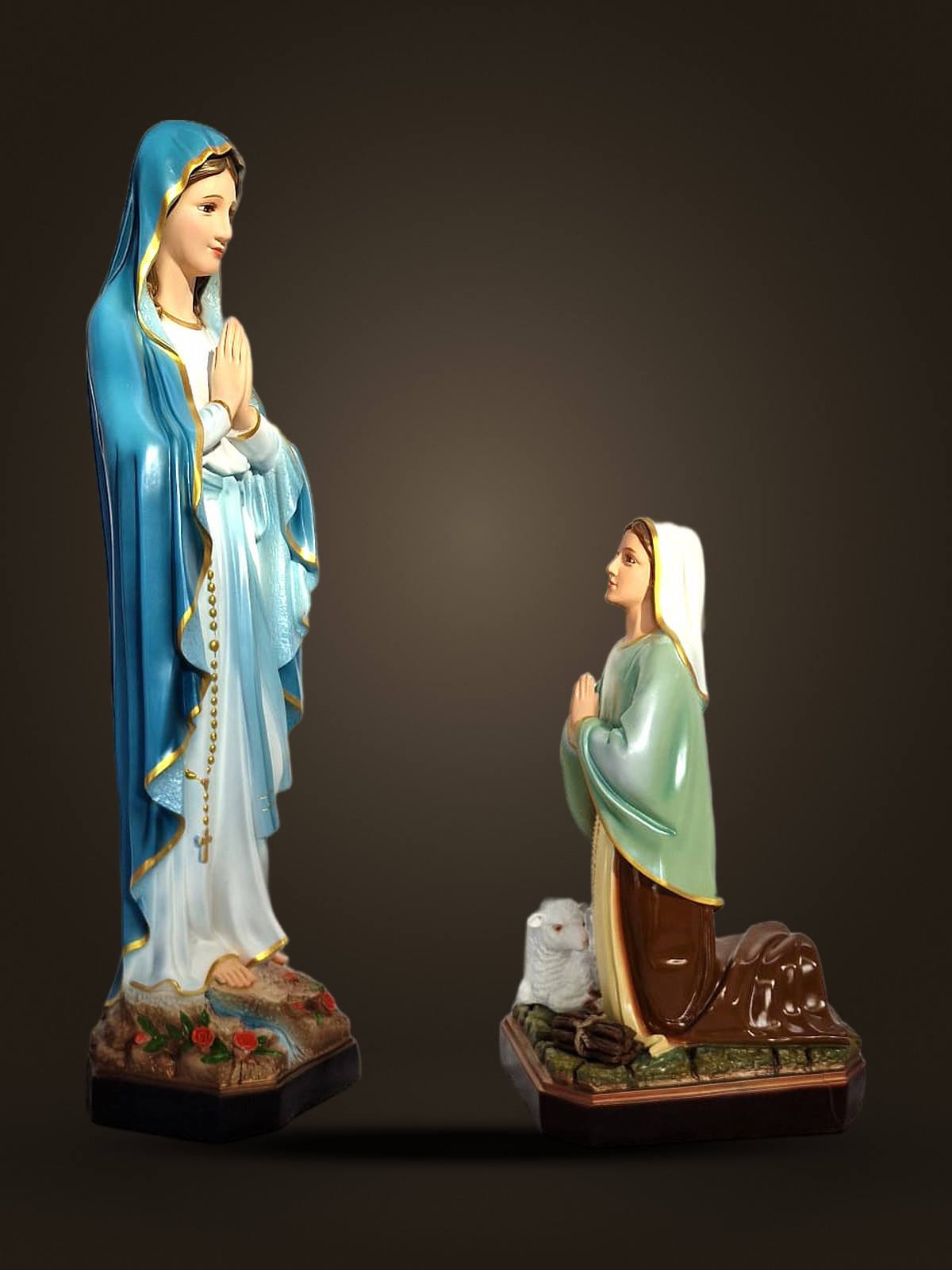
Our Lady of Lourdes and St Bernadette
Hand-painted resin · the pair
€240
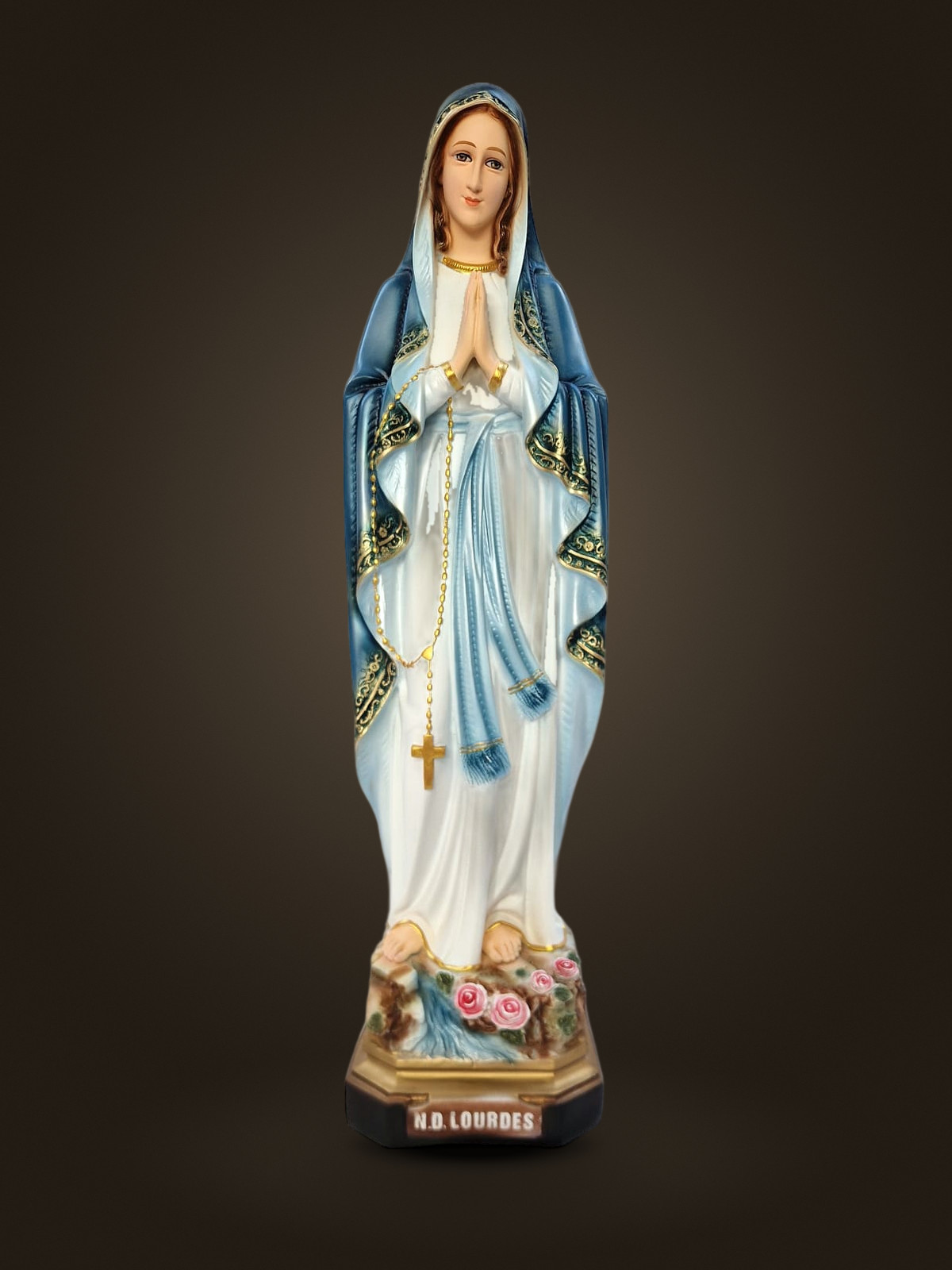
Our Lady of Lourdes (Hand-Painted)
Hand-painted resin · shaded finish
€95
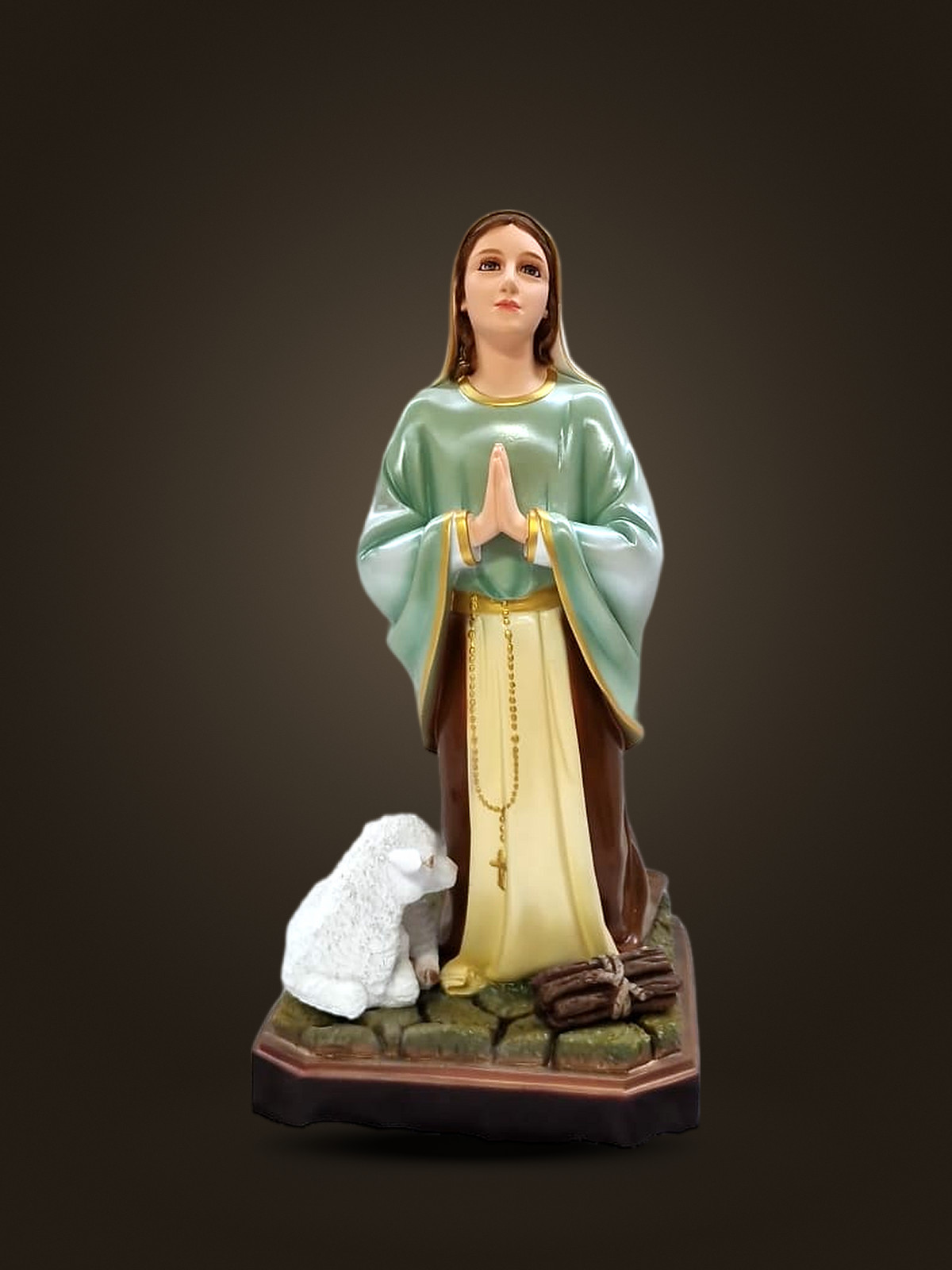
St Bernadette
Hand-painted resin
€120
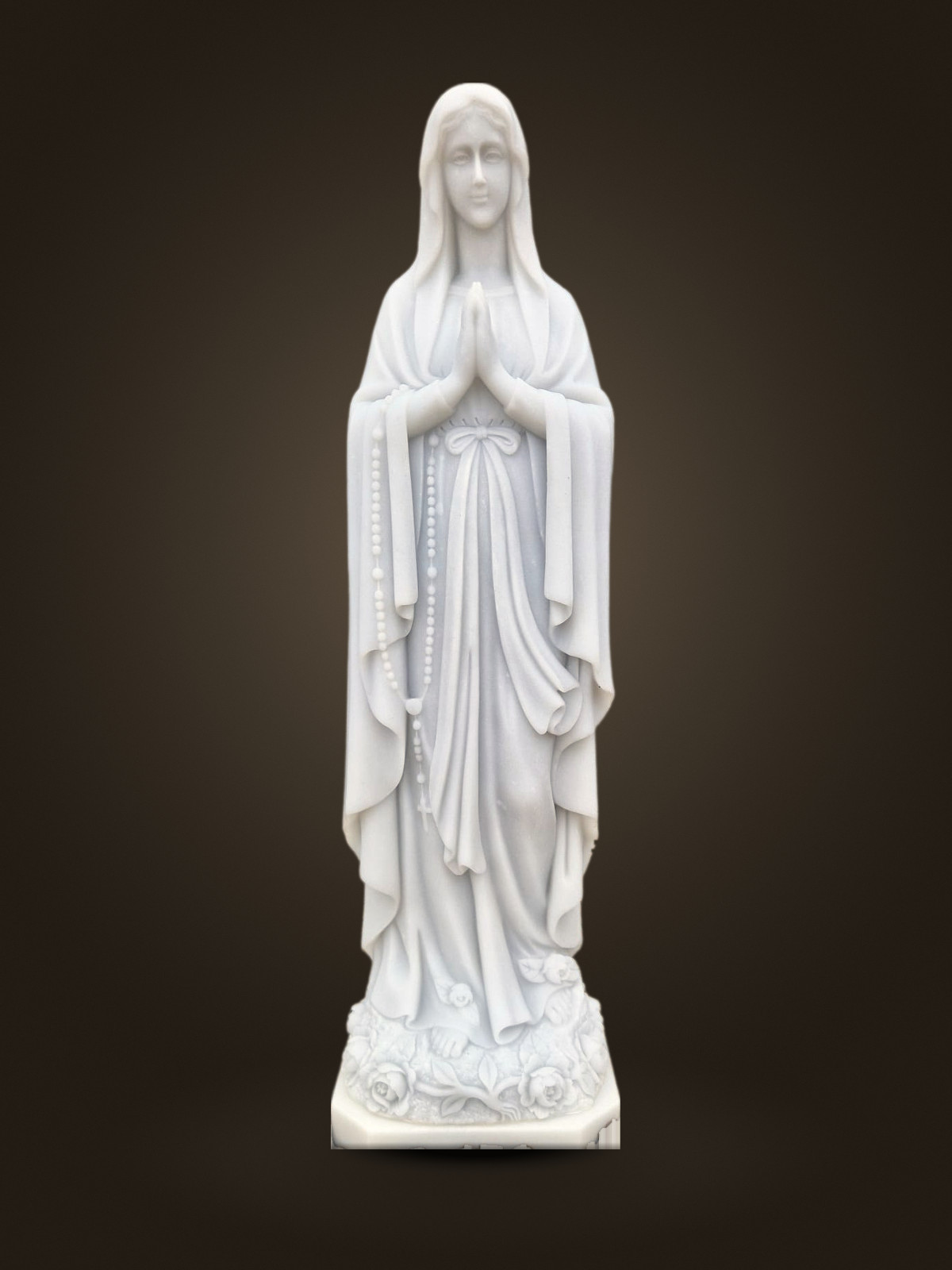
Our Lady of Lourdes (Fine Detail)
Hand-carved marble · 3ft 3in
€2,400
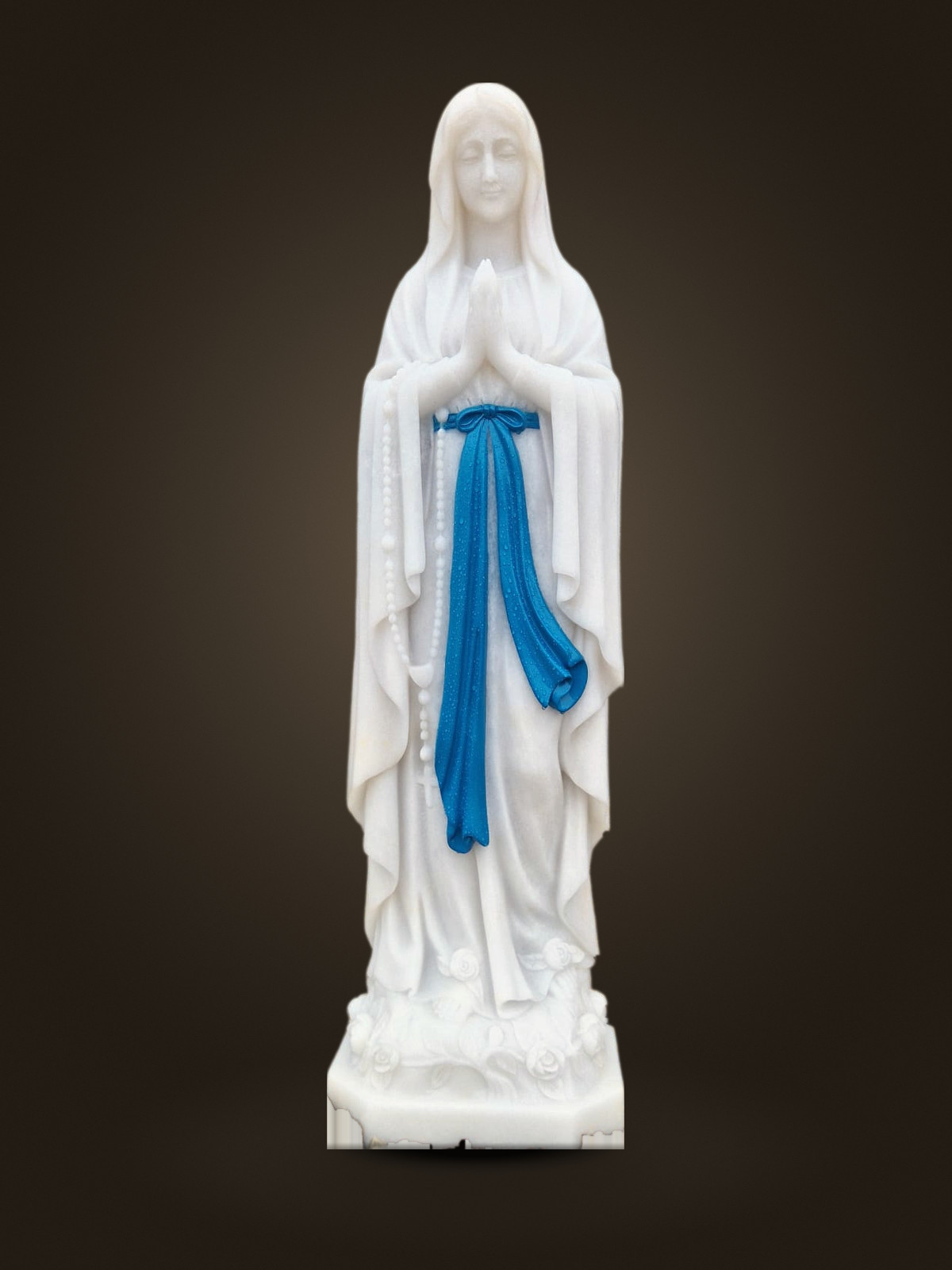
Our Lady of Lourdes (Blue Ribbon)
Hand-carved marble · blue ribbon
€2,100
Lourdes in Ireland
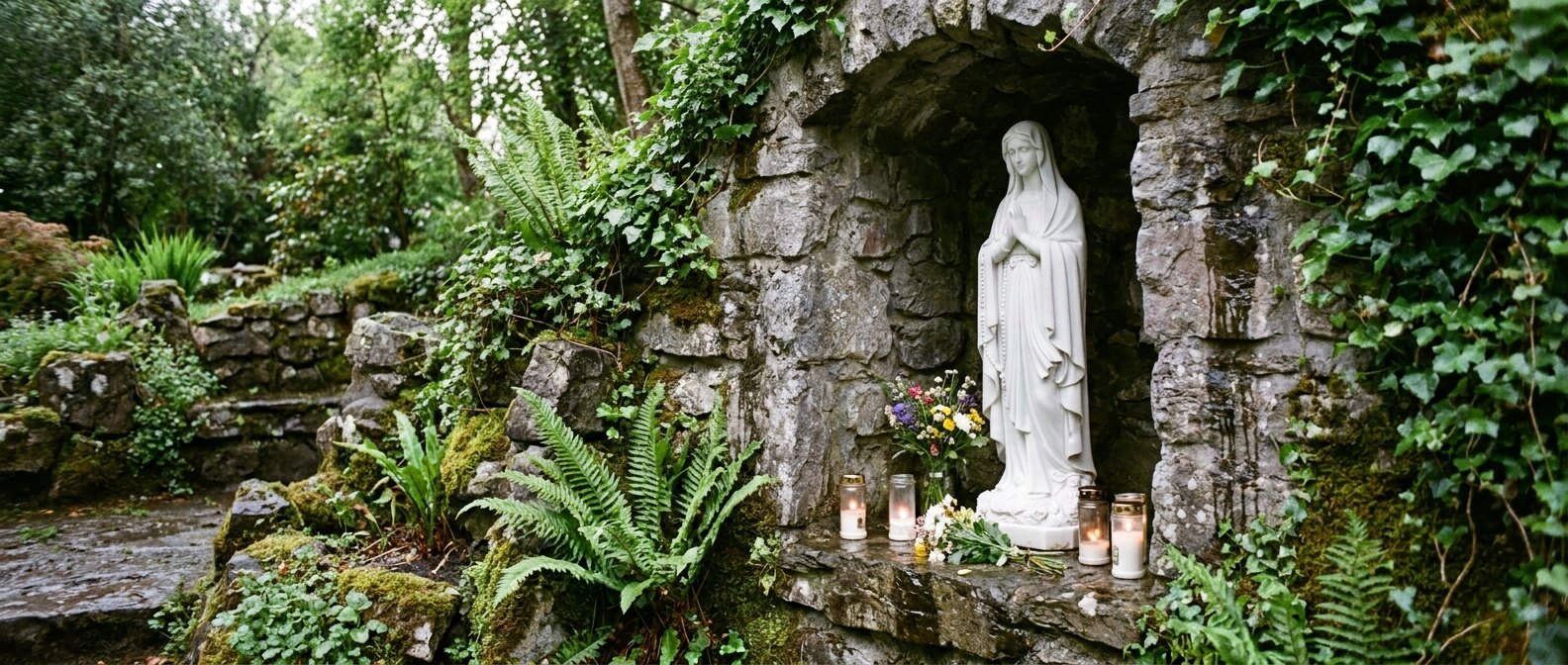
Look at almost any Irish parish grotto and you are looking at Massabielle: a rocky niche, a white statue of Our Lady with a blue sash, and often Bernadette kneeling below. Many were built for the Marian Year of 1954, the centenary of the dogma of the Immaculate Conception, and they are still kept with flowers and candles.
A Lourdes statue is the classic choice for a grotto at home or in a parish, and a natural gift for anyone who has been to Lourdes, or who is sick or caring for someone who is. Our guide to making a garden grotto shows how to build one, and the grotto statues page brings the suitable pieces together.
Questions people ask
How many times did Our Lady appear at Lourdes?
Eighteen times, between 11 February and 16 July 1858, all to St Bernadette Soubirous.
What did Our Lady say at Lourdes?
She asked for prayer for sinners and for penance, asked for a chapel and for processions, showed Bernadette the spring, and on 25 March 1858 named herself: “I am the Immaculate Conception.”
When is the feast of Our Lady of Lourdes?
11 February, the anniversary of the first apparition. It is also the World Day of the Sick.
When is St Bernadette’s feast day?
16 April, the day she died in 1879 at Nevers.
Which statue goes with Our Lady of Lourdes in a grotto?
St Bernadette, kneeling, is the traditional companion. Choose a Bernadette in proportion to the Lourdes statue, usually a little smaller, as she kneels.
Can I use Lourdes water at a home grotto?
Yes. Lourdes water is ordinary spring water from the grotto, with no special properties of its own; many people sprinkle a little at a home grotto as a sign of prayer and of their link with Lourdes. On marble, dry it off afterwards to avoid water marks.
Read next
Updated
Read next
Making a garden grotto
Grottos to Our Lady are part of the Irish landscape — at crossroads, outside schools and churches, in front gardens. A small one at home is within reach of anyone with a free corner and a weekend.
Grotto statues
Almost every Irish parish has one: a rock grotto with Our Lady of Lourdes in a niche above and St Bernadette kneeling below. Here is the story behind it, and how to choose statues for a grotto of your own.
Our Lady of Knock
On a wet Thursday evening in August 1879, people in a small Mayo village saw Our Lady, St Joseph and St John the Evangelist at the gable wall of their parish church. Not a word was spoken. Ireland has been going to Knock ever since.
Our Lady of Fatima
Between May and October 1917, three shepherd children in a Portuguese hill village saw a Lady “brighter than the sun”. She asked them to pray the Rosary every day.